

 Financial coaching
Earlier in my career, I assumed that providing support in personal finance was mainly about providing the right answers. I thought that, if you understand pensions better, or invest more efficiently, things would fall into place.
What I’ve learned since is that knowledge is only part of the picture. Many people have a sense of what they should be doing, yet they don’t. It could be down to feelings of overwhelm, confusion, lack of confidence, unhelpful money beliefs or just an absence of motivation.
Others are confident with day-to-day finances, but want help making sense of the long term. Occasionally, people simply need space to talk through money without being told what to do next.
Over time, I’ve noticed that individuals and couples tend to move between five broad levels of support when it comes to personal finance. These aren’t steps on a ladder and they’re not tied to age or wealth, although I think there can be a natural progression as you navigate through life.
It begins with building knowledge through financial education, but that alone is rarely enough. Decisions need to be made and action must be taken.
Financial guidance and coaching can help to personalise things, especially around behaviours and emotions, whilst financial planning brings more analytical, long-term strategic thinking.
Finally, regulated financial advice can help to fine-tune investments, optimise tax efficiency and to manage risk.
Often, people will benefit from a blend of two or more types of support.
If you’ve ever wondered, “What kind of financial help do I actually need?”, this framework can help you answer that question. Let’s look at the five steps in more depth.
1. Financial education
Financial education is about learning how money works, without any immediate pressure to take action. It tends to be more theoretical and there are many great resources available, including books, podcasts, YouTube videos, news articles and online courses.
People regularly tell me they wished they had learned more about money in school. These days, various organisations partner with schools to help, but we’re still a long way from delivering a comprehensive and consistent financial education in schools.
I’ve been an Education Champion with the Personal Finance Society for more than four years. This involves the delivery of financial topics for young people in secondary schools free of charge, and you can find out more about the programme here.
This level of support is incredibly important, and in truth, it never really ends. The world of personal finance keeps changing, and even if you feel confident with money now, you’ll still need to learn new things over time.
What education doesn’t guarantee, though, is action. You can build up knowledge, yet still feel stuck.
Over time, an improved understanding of how money works can build confidence and reduce fear. It can provide you with language, context, and a sense that money doesn’t have to be intimidating. But sometimes, a little bit of knowledge can lead to more confusion. It might create more questions than it provide answers.
Financial education is like laying a solid foundation, which makes it easier to build up to the next level. That’s where learning leads to decision-making and action.
2. Financial guidance
At this level, you may be seeking practical help to make and implement decisions. Most people would generally think of this as “advice” and in the context of financial services, it’s where a lot of confusion arises.
For the purposes of this article, let’s assume that “advice” means the 5th level of support covered further below i.e. regulated advice. “Guidance” means generic support, helping you to make your own decisions.
Guidance tends to use language like:
“People in your position might consider…”
Rather than:
“I recommend that you should do this.”
This distinction matters, particularly when it comes to choosing financial products like investments and pensions. Specific recommendations of products and product providers is a regulated activity, reserved for authorised individuals with appropriate qualifications, professional insurances and regulatory controls.
Imagine someone in their early forties who has built up some savings and wants to start investing for the first time. They’ve read a few books, listened to podcasts and they now understand the basics.
Through online resources and guidance-based content, they learn that people in their position often consider using a Stocks & Shares ISA, investing regularly, and spreading money across different types of investments.
That’s guidance, and it can help to narrow the options and build confidence in taking a first step.
What it doesn’t do is answer more personal questions like:
- How much risk is right for me?
- What provider should I choose?
- How does this fit alongside my pension, mortgage and family goals?
- What if I’m emotionally uncomfortable when markets fall?
In the UK, financial guidance is not regulated and does not involve personalised recommendations. There are no consumer protections at this level, and individuals remain fully responsible for their own decisions.
And without support to explore your emotions, priorities or competing life goals, procrastination may set in and progress can stall.
Nevertheless, financial guidance can be incredibly useful. It can help you weigh up the options, understand trade-offs and build confidence in making decisions. It’s more affordable compared to full advice and in many cases, can be free of charge.
A great place to start for both education and guidance is the UK government’s MoneyHelper website.

3. Financial coaching
Financial coaching fosters an environment that shifts gently away from fixing an immediate problem to creating lasting change. Although it can help you with what you should do, it can also allow you to explore how you think, feel and behave around money.
At this level, the work becomes far more personal. Not in the sense of giving personal advice, but in helping you develop clarity, confidence and self-awareness.
Money decisions are rarely just technical; they’re shaped by emotions, habits, values and life experiences. Coaching creates space to explore all of that.
In practice, this form of support will likely include a degree of financial education and guidance, but it goes deeper. Any kind of coaching is an investment in yourself and should be seen as a form of personal development, not just a way to get financial answers. It’s about creating and embedding new levels of understanding, habits and behaviours.
A key difference here is that financial coaching should feel as though you’re in the driving seat, not that you’re being forced through a process. There’s no predefined checklist or “right” answer. Instead, the agenda is driven by what matters most to you and your current life stage.
It often involves:
- Reducing overwhelm and mental clutter
- Building clarity on your goals and priorities in life
- Connecting money decisions to wider life goals
- Exploring emotional responses to money
- Identifying and changing unhelpful patterns or behaviours
For many people, financial coaching makes money feel less intimidating and more manageable. Rather than adding to the overwhelm, coaching can help to simplify things.
Importantly, financial coaching doesn’t remove responsibility or replace decision-making. It supports people to make their own choices with greater confidence, rather than relying on “rules of thumb”, comparisons or external validation.
In my experience, this level of support resonates well if you already have some financial knowledge but feel stuck, conflicted or overwhelmed. It works particularly well if you are open to reflecting on the bigger picture of your life, not just the numbers.
What is a financial coach and why might you want one?
4. Financial planning
Financial planning is about stepping back and looking at the long-term shape of your life, with money as a supporting tool rather than the main event.
This form of support tends to work well once you’ve become comfortable managing your finances on a day-to-day basis. The questions shift from “Am I doing this right?” to “Where am I actually heading?”
Financial planning brings structure to those bigger questions. It involves thinking strategically about the future, exploring different scenarios and understanding how today’s decisions might play out over time. This can include modelling income, spending, assets and pensions to see how various choices affect the bigger picture.
When you work with an experienced financial planner, you’ll notice that they are skilled in helping you to articulate and quantify your future desired lifestyle. Together with the use of sophisticated lifetime cashflow modelling software, this collaborative approach can bring real clarity to the question “will I be ok, financially?”
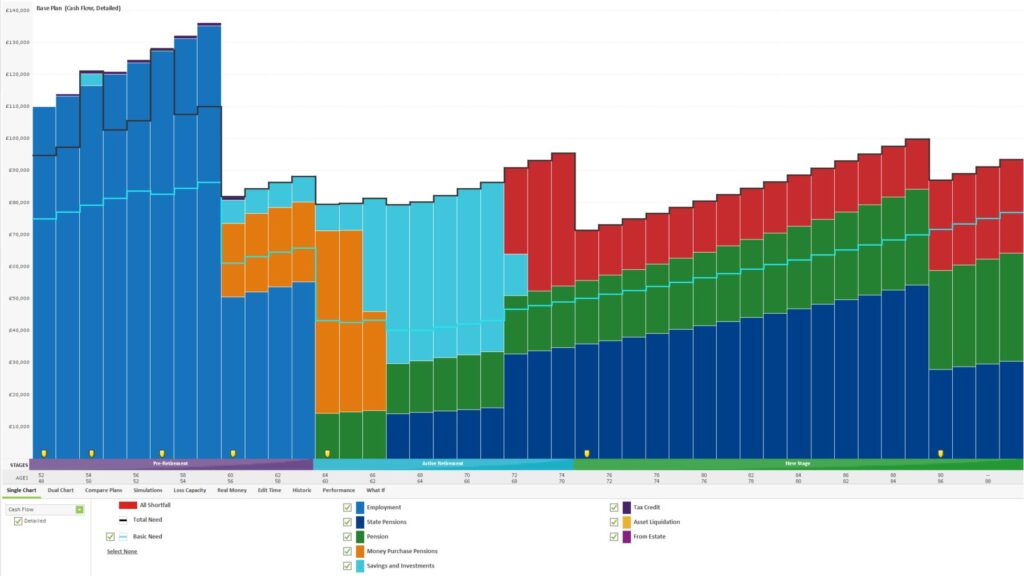
This level of support tends to works best when there’s enough clarity about life direction to make planning meaningful. Earlier in adulthood, there can simply be too many unknowns. Careers, relationships, health and location may all be in flux, which can make long-term modelling feel too abstract.
When the time is right, financial planning can be incredibly powerful in helping to:
- See the long-term implications of your choices
- Make trade-offs consciously rather than reactively
- Test “what if?” scenarios in a safe, structured way
- Feel more confident about the path you’re on
In its purest form, financial planning doesn’t require recommendations on specific products. It’s about making sense of complexity, not selling solutions. Compared with coaching, it may feel a bit more process-led and analytical, but if done on a collaborative basis, can be hugely empowering.
For some, financial planning can provide enough of a steer to help with big decisions, whilst for others, it becomes a stepping stone towards regulated advice.
As a Chartered Financial Planner and financial coach, I offer a blended approach with what I call “coaching-led financial planning”.
You can read more about that in my earlier blog here.
5. Financial advice
At this level, you can expect to receive specific, personalised advice about what you should do with your money. This typically involves the recommendation of pensions, investments, retirement income, tax planning or estate planning. In the UK, this type of advice is regulated and comes with formal consumer protections.
Another distinguishing feature of financial advice is that it’s often delivered as an ongoing relationship, rather than a one-off interaction. In addition, financial advisers don’t just make recommendations. They typically implement them and continue to manage your investments over time.
This ongoing role can include:
- Constructing and managing investment portfolios
- Monitoring performance and risk
- Making adjustments as markets, legislation or personal circumstances change
- Providing regular reviews and reassurance
This level of support becomes particularly valuable when decisions are complex, high-value or difficult to reverse. This may include the areas of retirement, estate planning, wealth management and long-term income planning.
Because advisers are taking responsibility for implementation and oversight, the process is necessarily more structured and formal than earlier levels of support. That structure can be reassuring, but for some, overwhelming and confusing. Financial advice isn’t always the right fit, so you need to consider what’s right for you, based on your circumstances and preferences.
It’s worth noting that fewer than 10% of people in the UK work with a regulated financial adviser. There are various reasons for this, one being that for many people, this level of support is simply not needed……or at least, not yet.
My view is that regulated advice delivers the greatest value when it’s built on strong foundations and for that, education, guidance, coaching and planning can work wonders.
Used well, financial advice doesn’t replace personal responsibility. It complements it and can work very well in conjunction with coaching and planning.
As a financial coach, I do not provide regulated advice and all of my work is completely independent of product providers, commissions or percentage-based fees.
Summary
These five levels of support are not mutually exclusive. They’re different forms of help, designed to meet different needs. People move between them, or use more than one at the same time.
Financial coaching, for example, is not an alternative to financial advice, nor is it in competition with it. They serve different purposes. Coaching focuses on clarity, confidence, self-awareness and action. Advice focuses on implementation, optimisation and ongoing management. Used together, they can be incredibly powerful.
What matters most is not the label, but the fit. Good financial support meets you where you’re at, respects your autonomy, and adapts as your life changes.
Sometimes what’s needed is knowledge and understanding. Other times it’s space to think. Sometimes it’s structure, reassurance or professional oversight. Often, it’s a blend.
The right support isn’t about status, age or wealth. It’s about finding the combination of help that allows you to make informed decisions, with the confidence and motivation to take action.

 Production