

 Financial coaching
Trying to find a regulated financial adviser can feel a bit like looking for a needle in a haystack.
There are more than 30,000 regulated financial advisers in the UK, all offering slightly different services. There will be differences in how they charge, yet they often use similar language to describe what they do.
It can be difficult to know where to start. What qualifications should you look for? Should your adviser be independent? How much should you expect to pay? How comfortable will you feel in their company?
And do you even need regulated financial advice in the first place?
The UK regulator of financial advice, the Financial Conduct Authority (FCA) published a survey earlier this year: “Understanding the advice market: financial advice firms survey 2025”.
The survey shows there are around 4.1 million retail clients who use the services of a financial adviser in the UK. It’s a big number, but it only accounts for around 9% of UK adults. Not everyone needs, wants or has access to regulated advice.
Financial advice can be extremely valuable when you need a professional recommendation about pensions, investments or other regulated financial products. But not every financial decision requires regulated advice. Sometimes the real need is for good financial planning: understanding where you are now, working out where you’d like to be in the future and exploring the options available to you.
Typically, when individuals and couples come up against a financial problem, their first thought is to speak with a financial adviser. But they may discover that regulated financial advice isn’t quite what they need.
The FCA describes a typical adviser as working with around 150 clients, each with approximately £250,000 of assets, generating around £2,000 of revenue per client. It also found that 88% of advised clients receive ongoing advice.
This indicates that much of the regulated financial advice market is designed around long-term relationships with people who already have significant pensions and investments to manage. Many of the people I work with aren’t at that stage. They may need help getting organised, understanding their choices and developing a financial plan before deciding if product recommendations are needed at all.
Do you actually need regulated financial advice?
Before you start searching for a financial adviser, it’s worth taking some time to understand if this will actually solve your problem.
The important distinction is the personal recommendation.
A regulated financial adviser can assess your individual circumstances and recommend a particular course of action, usually involving regulated financial products. For example, a pension, investment or retirement income product.
A good financial adviser will likely begin with some robust financial planning. That should include exploring your goals, reviewing your wider financial position and using lifetime cashflow modelling to help you understand the impact of different choices.
In that sense, there can be some overlap between regulated advice and non-regulated financial planning. A regulated adviser may use similar planning tools and conversations as a non-regulated planner. The difference is that their planning can form part of a regulated advice process and ultimately lead to a personal recommendation about particular financial products.
My coaching-led financial planning work has a different destination. The aim is to empower clients to make their own informed financial decisions, rather than suggest what they should do.
That might involve helping someone answer questions such as Where am I now? Where do I want to get to? What choices do I have? What might those choices look like over my lifetime? We can explore different “what if” scenarios and model the financial impact of those choices. We can discuss the advantages and disadvantages of different options, but the decision remains firmly with the client.
Coaching-led planning does not lead to a recommendation to buy, sell or switch a particular regulated financial product.
A regulated adviser can take the process further. Where appropriate, they can recommend which particular pension, investment or other regulated solution they believe is suitable for you.
That recommendation also comes with important responsibilities and consumer protections. The adviser must consider whether what they recommend is suitable for your circumstances.
So the distinction isn’t really financial planning versus financial advice. Good regulated advice may include excellent financial planning.
It is more about what you need from the process. Do you want help understanding your position, exploring your choices and becoming confident enough to make your own decisions? Or do you need someone to make a regulated personal recommendation on your behalf?
Both approaches can be valuable. The right one depends on the decision you are trying to make.
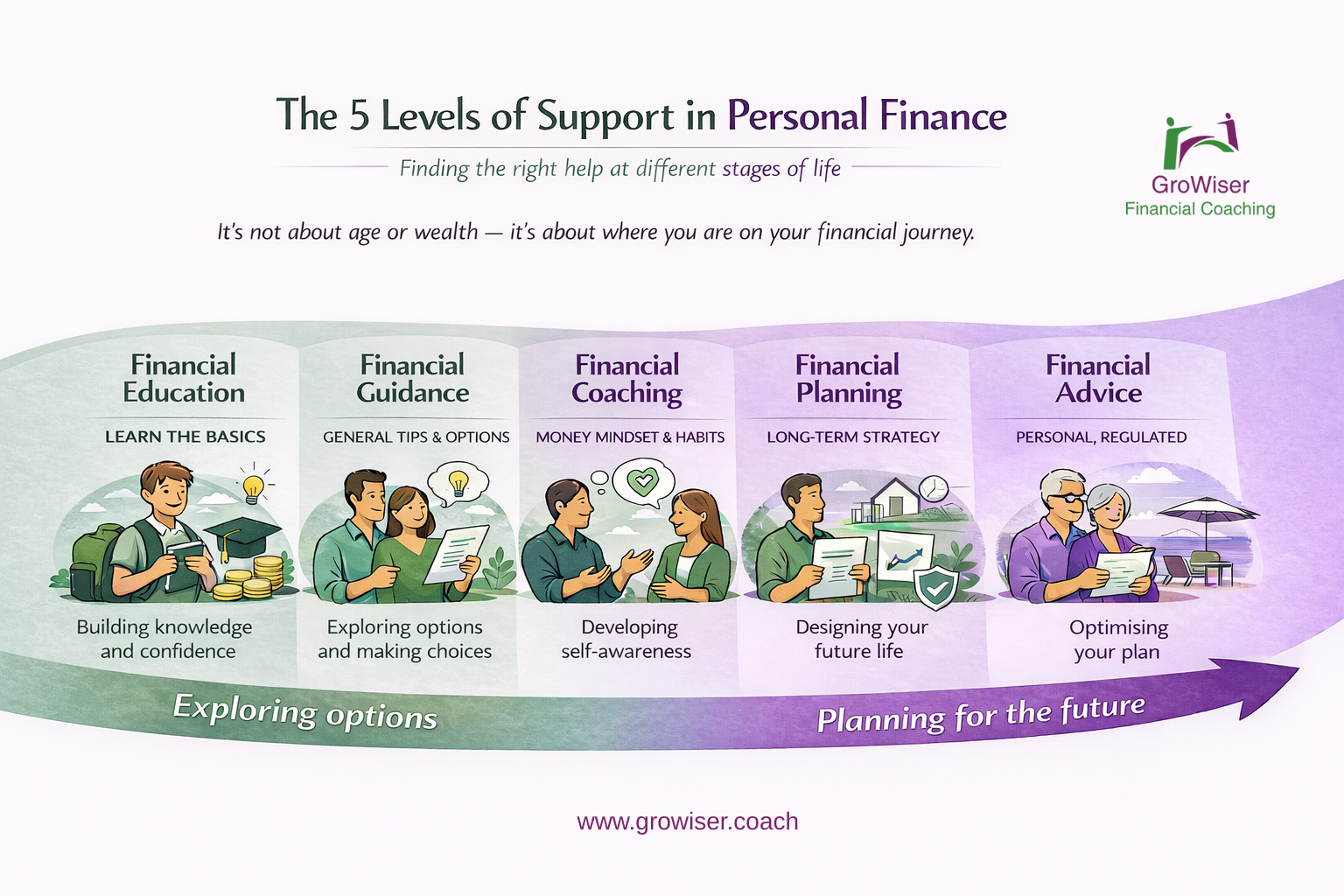
In my earlier article, The 5 levels of support in personal finance, I explored these different types of support in more detail. If you’ve concluded that regulated advice is what you need, the next challenge is finding an adviser who is right for you.
What should you look for in a financial adviser?
Once you’ve decided that regulated financial advice is for you, the next question is: what should you actually look for?
There is no single definition of the “best” financial adviser. The right adviser for you will depend on your circumstances, the type of advice you need and the kind of relationship you want to have.
Here are some of the things worth considering:
Appropriate qualifications and regulatory status
Make sure any potential adviser is properly authorised to provide the type of advice you need. You can check this on the FCA’s Financial Services Register here.
All regulated financial advisers must meet minimum professional qualification standards, but some choose to go further. Qualifications such as Chartered Financial Planner or Certified Financial Planner can indicate a higher level of technical knowledge and professional development.
Qualifications matter, but don’t choose an adviser based upon letters after their name alone. Experience and the ability to communicate well are just as important.
Experience that is relevant to you
It may be helpful to find an adviser who regularly works with people in circumstances similar to your own. Someone approaching retirement may have very different needs from a business owner, a young family or a couple who are separating.
Likewise, some advisers specialise in areas such as pensions, later-life planning or inheritance tax and estate planning.
You don’t necessarily need a narrow specialist, but you should feel confident that the adviser understands the type of decisions you are facing.
Once you have a shortlist of prospective advisers to work with, it’s worth asking them who they typically work with.
A service that matches what you need
One of the most important questions is whether the adviser’s business model actually fits what you are looking for.
Some advisers specialise in long-term ongoing relationships, while others are happy to provide advice on a one-off basis. Some firms have minimum levels of investments or pensions before they will take on a client.
Nowadays, many advisers centre their work around lifetime cashflow modelling and might use terms like “lifestyle financial planners”. Others may still be led more by investment solutions and technical advice.
None of these approaches are inherently right or wrong. The important thing is to understand what you are signing up for.
If you only want help with a specific decision, it makes little sense to enter an ongoing relationship that you neither need nor value.
Clear and transparent charges
You should be able to understand how the adviser will be paid, what the initial advice will cost and what you will pay in future if you continue working together.
Don’t be afraid to ask for charges to be explained in pounds and pence, rather than percentages alone.
Cost matters, but it’s important not to automatically choose the cheapest adviser. The better question is whether the service and expertise being provided represent good value for what you need.
Independent or restricted advice
It’s also worth understanding whether an adviser is independent or restricted.
An independent adviser must consider a broad and diverse range of relevant products and providers when making recommendations. A restricted adviser works within some form of limitation, which might relate to particular products, providers or the type of advice they offer.
Restricted does not automatically mean poor advice, and independent does not automatically mean better advice. What matters is understanding the restriction and deciding whether you are comfortable with it.
I always remember being taught to think of an independent financial adviser (IFA) as acting as an agent on behalf of the client, rather than being tied to the interests of a particular provider or employer. That isn’t the FCA’s technical definition of independence today, but I still think it is a useful way of understanding the spirit of the distinction.
Someone who communicates in a way you understand
Good financial advice should make things clearer, not more confusing. You should feel able to ask questions without embarrassment and expect explanations in language you understand. Be wary if you leave a conversation feeling overwhelmed by jargon or unable to explain what is being recommended and why.
Financial decisions are often deeply personal. They can involve hopes, worries, family relationships and some of the biggest decisions you will ever make.
That means the human relationship is critically important. Generic financial guidance, and even the most sophisticated artificial intelligence, can provide useful information and support, but neither can replicate the relationship you build with a trusted professional. Someone who takes the time to understand you, your circumstances and what really matters to you.
A good adviser will listen not only to what you say, but also notice what you don’t say. The hesitations, assumptions and unspoken concerns that can sit behind important financial decisions.
Someone you trust and feel comfortable with
Ultimately, you may be sharing a great deal of personal information with your adviser, and potentially working with them for many years.
Do they listen carefully and seem interested in what matters to you, rather than the amount of money you have available to invest? Do you feel under pressure, or do they create a safe space for you to think?
Some of this will come down to instinct. A highly qualified adviser with a fancy office and shiny brochures may not be the right adviser for you if you don’t feel comfortable talking openly with them.
The aim isn’t to find the adviser with the longest list of qualifications or the most sophisticated website. It is to find someone who has the right expertise, offers the right type of service and feels like a good fit.
How do you find a good financial adviser?
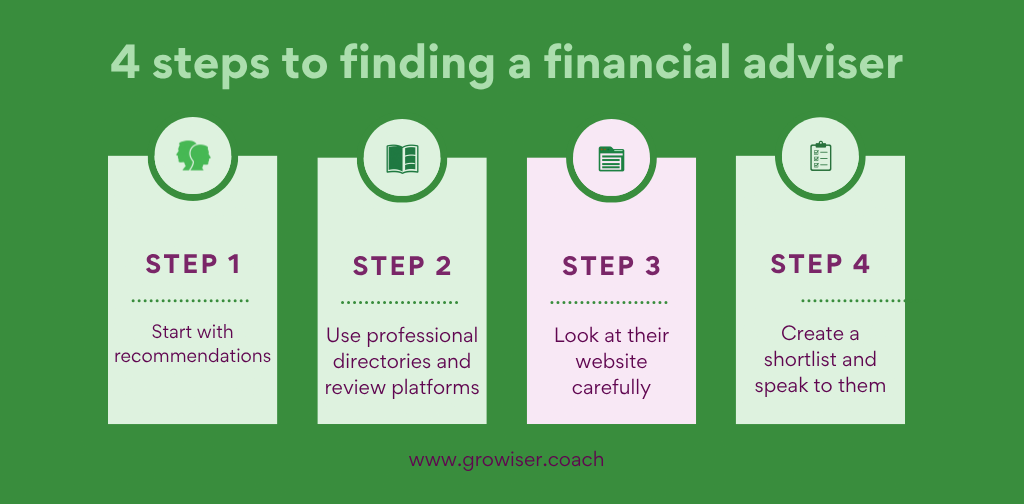
Once you have a clearer idea of what you are looking for, the next step is to create a shortlist of advisers to speak with.
-
Start with recommendations
A personal recommendation can be a useful starting point, particularly if it comes from someone whose circumstances or values are similar to your own.
That might be a friend, family member, accountant, solicitor or another professional you trust.
But remember that an adviser who is right for somebody else won’t automatically be right for you. Treat a recommendation as a name to investigate, rather than an endorsement you should simply accept.
As a financial coach, I won’t make a personal recommendation about which financial adviser you should appoint. My role is to help empower you to understand what you need, know what to look for and carry out your own research before making that decision for yourself.
-
Use professional directories and review platforms
There are several online resources that can help you build a shortlist. Professional bodies such as the Personal Finance Society and the Chartered Institute for Securities & Investment have searchable directories of advisers and financial planners. These can be particularly useful if you want to look for higher professional qualifications, such as Chartered Financial Planner or Certified Financial Planner™ status.
Another resource is VouchedFor, which allows you to search for advisers and read feedback from verified clients. Reviews are not a substitute for doing your own research, but they can give you a useful sense of what it is actually like to work with a particular adviser.
-
Look at their website carefully
Once you’ve found a potential adviser, spend some time looking beyond the homepage of their website.
Who do they say they work with? What problems do they specialise in solving? Do they talk mainly about investments and products, or about financial planning and life goals? Do they offer one-off advice or only ongoing relationships?
You can often learn a great deal about a firm’s philosophy from its website, articles or videos before you ever make contact.
This is also a good opportunity to revisit the criteria from the previous section and ask yourself whether the adviser appears to offer the type of service and planning relationship you are looking for.
-
Create a shortlist and speak to them
This might sound like a bit of work, but it’s really important. Identify three or four advisers that appear to meet your needs and arrange an initial conversation with each of them.
Most advisers offer an initial meeting without charge or obligation. Use that conversation to understand how they work, what they would provide and what it would cost. And just as important, how you feel talking to them.
Do they listen carefully or are they just pitching their service? Are things explained clearly or are you bombarded with technical jargon? How comfortable do you feel asking questions?
Are they interested in understanding you, or mainly in the assets you have available to invest?
You are not simply buying a financial product or solution here. You’re choosing someone who will become involved in some of the most important financial decisions of your life. Take your time.
The aim is not to find the adviser with the slickest website, the biggest firm or the most impressive sales pitch. It’s to find a shortlist of professionals so you can decide which one feels like the best fit.
What if you’re not ready for regulated advice?
You may go through this process and realise that regulated financial advice isn’t what you need right now.
Perhaps you don’t have a specific product decision to make. Maybe your bigger questions are about retirement, lifestyle, priorities or simply getting your finances better organised. Or maybe you need to change your relationship with money before you can even begin thinking about the longer term!
A coaching-led planning process can help you understand where you are now, identify what matters most and explore different options. The aim is not to tell you what to do, but to help you become confident enough to make your own informed decisions.
Often, that will be all the support you need. But sometimes, financial coaching and planning helps identify the point at which regulated advice becomes necessary. The sums involved may be significant, or your circumstances sufficiently complex to warrant regulated advice, with all the consumer protections that come with it.
Imagine being able to approach an adviser with a much clearer understanding of your objectives, your financial position and the specific advice you need.
Sometimes the most valuable first step is to take the time to develop a robust financial plan. Give yourself the space to explore your goals, values and priorities in enough depth to understand what you really want your money to help you achieve.
That process may eventually lead to regulated advice. Or it may give you the clarity and confidence to make your own informed decisions.

 Production